





The AER Engine and the Aero Economy
Introduction
Today, Aerodrome and Velodrome combined represent the industry’s single highest-revenue decentralized spot exchange—having delivered over half a billion in revenue to token operators.
And soon, they’ll merge to form Aero, designed from the ground up to serve as the unified liquidity layer for all of Ethereum and the definitive onchain spot exchange.
Aero will be the first decentralized exchange built on MetaDEX03, the latest DEXOS from Dromos Labs, making it the most technologically and economically advanced exchange on the market: introducing first-of-their-kind technologies such as internalized MEV auctions and upgraded dynamic fees.
And it will also be the first protocol to be powered by Predictive Allocation.
Aero will feature new twin economic engines: the REV Engine and the AER Engine.
The REV Engine layers additional revenue streams into the protocol and directs them toward the AERO token. It backs the AERO token with new sources of value and in turn enables the token to more efficiently compensate DEX liquidity providers for the risk they take on in facilitating token markets.
In this post, we focus on the AER Engine, a package of core economic upgrades designed to dynamically tether the AERO Rewards rate to pool revenue over time to help ensure both short-term competitiveness and long-term sustainability.
New Economics for the New Aero
To make Aero a forever DEX, its economic system had to be built for the new onchain era and be more adaptive and responsive than anything else on the market.
Which is why Aero’s upgraded economics will be more dynamic at every level:
- From counting tokens to managing value. The system shifts from accounting in units of tokens to dynamically managing units of value, minting only what is needed to win.
- Adaptive global policy. The economic policy actively calibrates to different market and competitive regimes, by predetermined rules tied to set criteria.
- The Aero Fed sets the global cap on AERO reward rates (i.e., the inflation rate).
- Gauge Caps set the per-pool ceiling on AERO reward rates.
- Predictive Allocation sets the per-pool level of AERO reward rates. Each pool’s rewards are determined primarily by token operators’ allocations (sAERO holders), who earn the revenue pools generate.
In short, the nature of rewards is changing: Aero will be maximally competitive and flexible while meaningfully limiting inflation, ensuring the system’s long-term sustainability.
A Powerful Adaptive Engine
The AER Engine is a pivotal leap in the industry-leading exchange economic model pioneered in MetaDEX02, the DEXOS underlying Velodrome and Aerodrome today. We have discussed one of its components, Predictive Allocation, at length; here we discuss the rest.
At launch, Aerodrome followed a transparent, predetermined rewards schedule enforced by immutable code until the Aero Fed turned on and rate became adjustable. Each week, emissions could be increased or decreased by 1 basis point or maintained at the same rate.
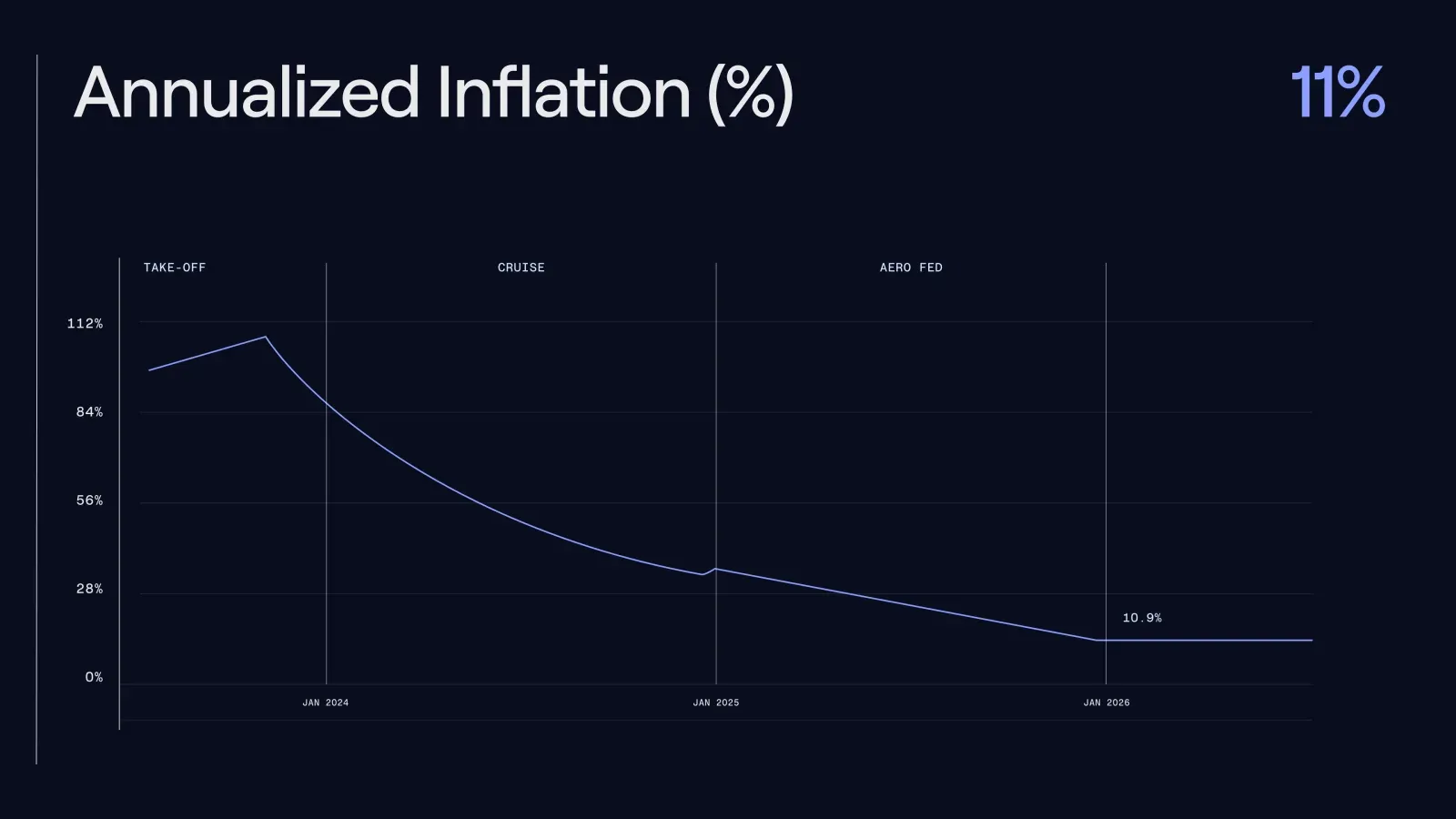
In this system, the minter emitted a set number of tokens every week, and those tokens were distributed to LPs. The reward rate was set as a percentage of total supply, with inflation measured by the number of tokens emitted rather than by their dollar value.
As a result, market conditions, competitive dynamics, and token prices could all change, but the rate of new AERO emitted mostly would not. That could leave too little or too much value emitted for the conditions; nonetheless, the dominance of MetaDEXs over legacy exchanges shows how well the system worked in aggregate.
MetaDEX02’s economics decomposed LP risk and shifted pieces of it to parties more willing to bear it. It moved ownership continuously toward active participants and away from entrenched, non-participating interests. It aligned all stakeholder classes. And it sustainably paid LPs more than the competition by streaming a token that, when locked, represented a full claim on the future revenue of the exchange itself in excess of fees.
MetaDEX03 keeps all of these innovations and adds an economic paradigm shift: from a system that optimizes quantities to one that measures and optimizes value, yielding large efficiency gains to outcompete in a shifting, growing industry.
How the AER Engine Works
Aero makes rewards value-denominated for the first time. Rather than minting a fixed number of tokens and letting their dollar value float, the AER Engine targets a dollar value of rewards per pool—a multiple of that pool’s projected revenue—and mints only the tokens needed to hit it.
At the pool level, two controls do this:
- Predictive Allocation: Where rewards go. Token operators (sAERO holders) continuously steer allocation toward pools that are actually earning fees.
- Gauge Caps: How much each pool can get, by value. Each pool’s reward value is held to a multiple of its revenue.
Everything below is how those two controls come to life in MetaDEX03 and the all new Aero.
Details and Key Changes
The Global Rewards Cap
Today, Aerodrome’s inflation rate stands at ~12% and Velodrome’s at ~16%. At launch, the global rewards cap is expected to cap inflation at 20% annualized, but this is a ceiling, not a target. The realized annual inflation rate will be calibrated by the AER Engine and is expected to run well below the global rewards cap; we estimate 8%–12%.
The Minter
In MetaDEX02, the minter emits a set number of tokens into gauges every seven days. In MetaDEX03, Aero’s minter becomes accounting-based: gauges will intelligently track the rewards owed to LPs, and tokens will only be minted when claimed.
The minter runs at a fixed reward rate per second, set by the global reward cap, but now each gauge accrues at its own rate:
- A gauge’s theoretical ceiling rate = the minter rate × its share of allocation weight (set by token operators). Rewards accrue to active-tick LPs and are minted on claim.
- However, every gauge will be given a custom rewards rate—enforced by a Gauge Cap—that limits how quickly rewards accrue to LPs based on pool revenue.
The global reward cap is set at a theoretical maximum value that would only come into play in healthy market conditions where there is a lot of revenue to be gained. Practically, the sum total of gauge caps based on pool revenue will never reach the global cap. Because these tokens never enter the accounting system, they never get minted, preventing unnecessary inflation.
The system only ever pays what it needs to win; never more, never less.
Gauge Caps
Gauge Caps tie the value of AERO Rewards that can flow to a given pool dynamically to that pool’s revenue (from swap fees, MEV fees, liquidity payments). Each gauge receives regular updates on its pool’s projected revenue, and its cap is adjusted dynamically to hold rewards at a fixed ratio of that projected revenue. Caps can be adjusted at any duration; at launch, we expect to recalibrate every 48 hours to mirror the initial sAERO allocation windows.
The Fed
The Fed Governor contract remains part of Aero’s economic architecture, however, we do not expect it to play a major (if any) role in Aero, as the AER Engine will already be dynamically adjusting the rewards rate to maintain the relationship between the value of rewards and the pool revenue. The Fed will primarily be a tool used as a fall back if needed to manage long-term protocol economics as the onchain economy grows.
What this Means
Token rewards flip from token-denominated to value-denominated for the first time. Consequently, Aero can compensate LPs reliably and strategically—higher than competing DEXs, but never more than necessary. Capturing more value, while spending less.
How it All Works Together: An Example
Take a single WETH/USDC pool that receives 10% of the total allocation weight.
In the old system, the pool gets 10% of the fixed weekly token emissions—the same token quantity regardless of price. So the value reaching LPs swings with the token, landing above or below the intended target.
In the new system, the Gauge Cap targets a reward value (a multiple of the pool’s revenue) and mints only the tokens needed to deliver it. Total inflation may range from 8–12%, but each pool’s reward value remains in a consistent, competitive band, measured in dollars, set per pool.
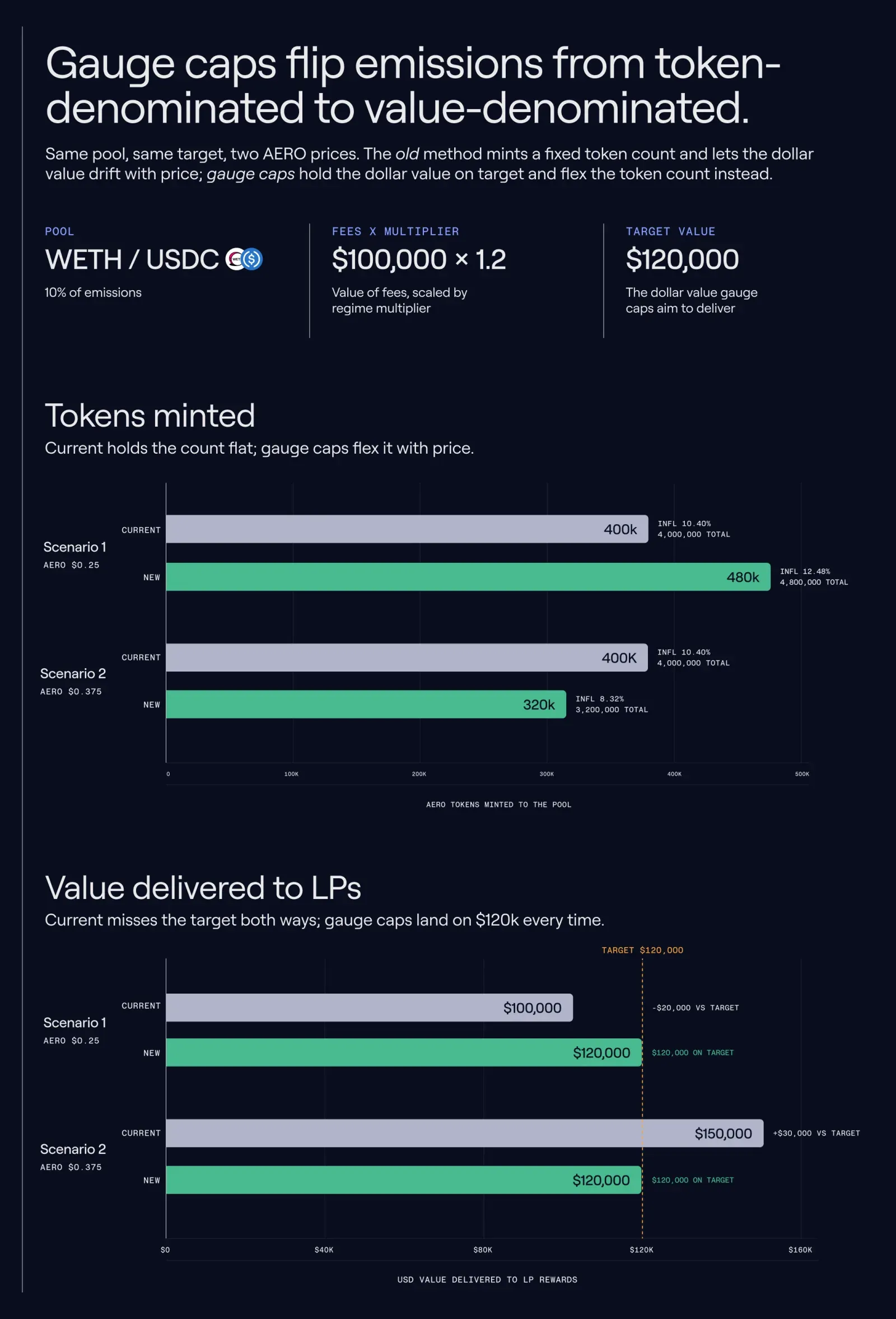
Recall that this is a secondary layer on rewards efficiency. Predictive Allocation is the first. Under Predictive Allocation, token operators regularly re-allocate toward pools that are earning fees, so rewards follow productive pools as the market moves. As the second layer, Gauge Caps, between allocation updates, keep each pool’s reward value pegged to its revenue. Allocation sets the direction of rewards, and caps set the magnitude.
Letting each pool’s reward value stay competitive means that the number of tokens minted—and thus realized inflation—must be free to move.
This is why the system still needs a hard ceiling on inflation: the global cap.
The market provided this ceiling under MetaDEX02. Because emissions were token-denominated, a falling AERO value automatically shrank the value of rewards, so the market itself limited how much real value the protocol spent. Aero replaces that implicit, value-driven limiter with an explicit cap and pegs rewards to pool revenue instead.
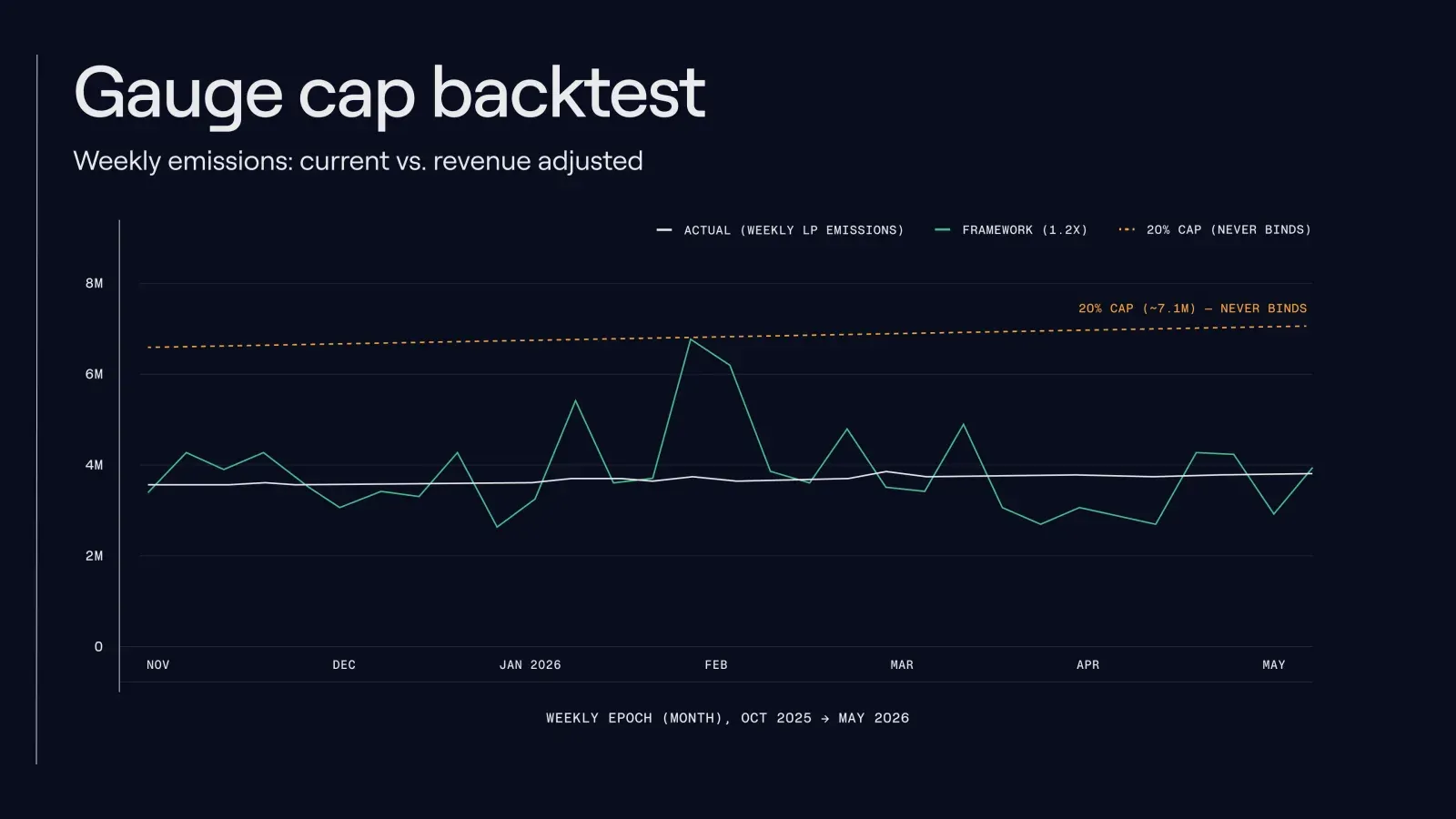
If this new framework was turned on at any point in the last ~7 months, inflation would have been nearly identical to the flat rate (3.9M/weekly vs 4.0M/weekly). But within this variance, emission value would have maintained a much more competitive posture as the market fluctuated.
In practice, Gauge Caps let Aero tune its competitive posture precisely across market regimes: inflation tracks revenue, remains under a hard ceiling, and is spent only where it’s productive.
The Engine of Global Onchain Liquidity
As we opened at the top, our goal is simple: become the leading onchain spot exchange across not just revenue, but every core exchange KPI. We won’t lay out the full plan here for strategic reasons, but the trajectory of Aero assuming undisputed category leadership is easy to follow.
This is closer than many assume:
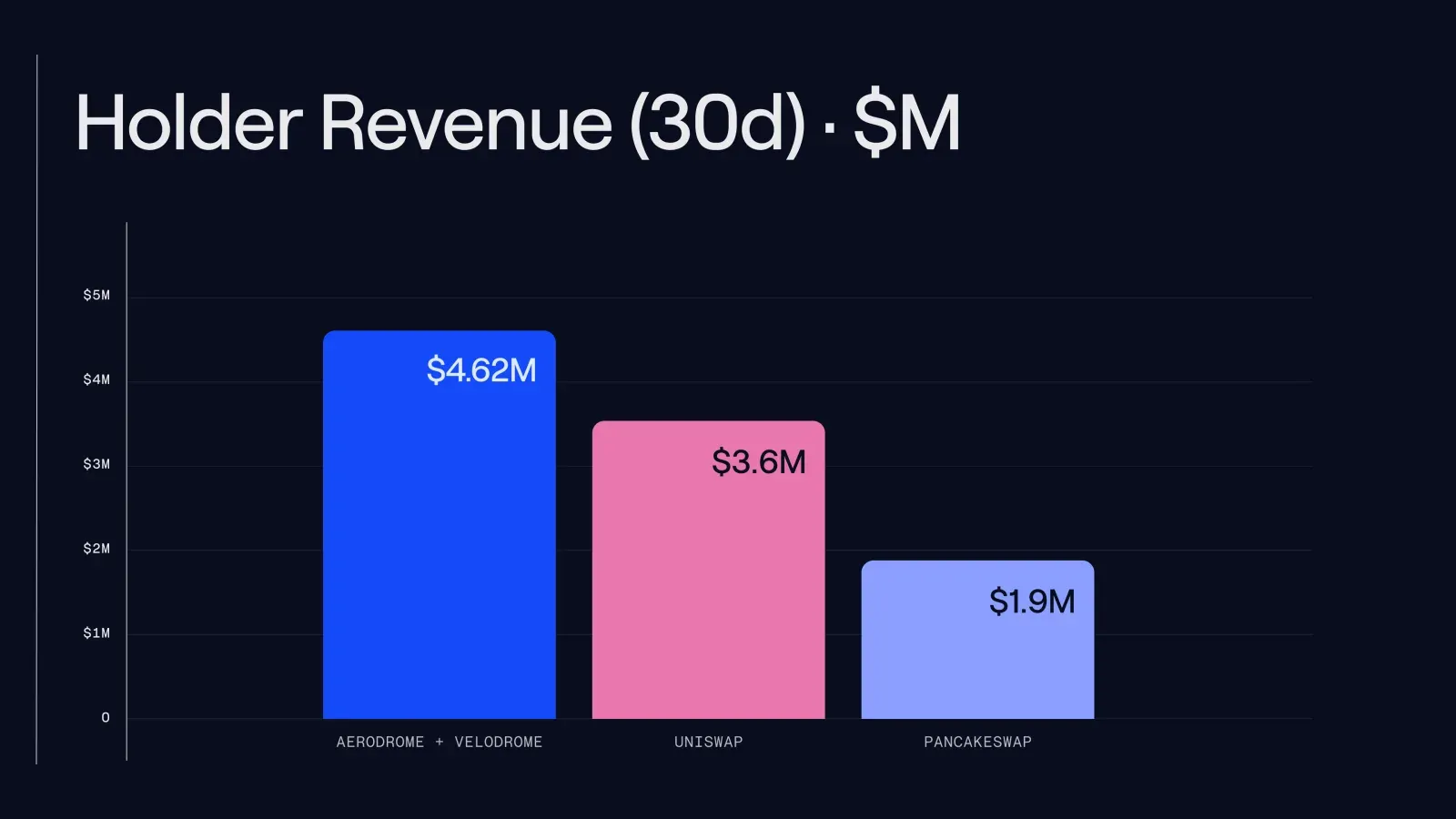
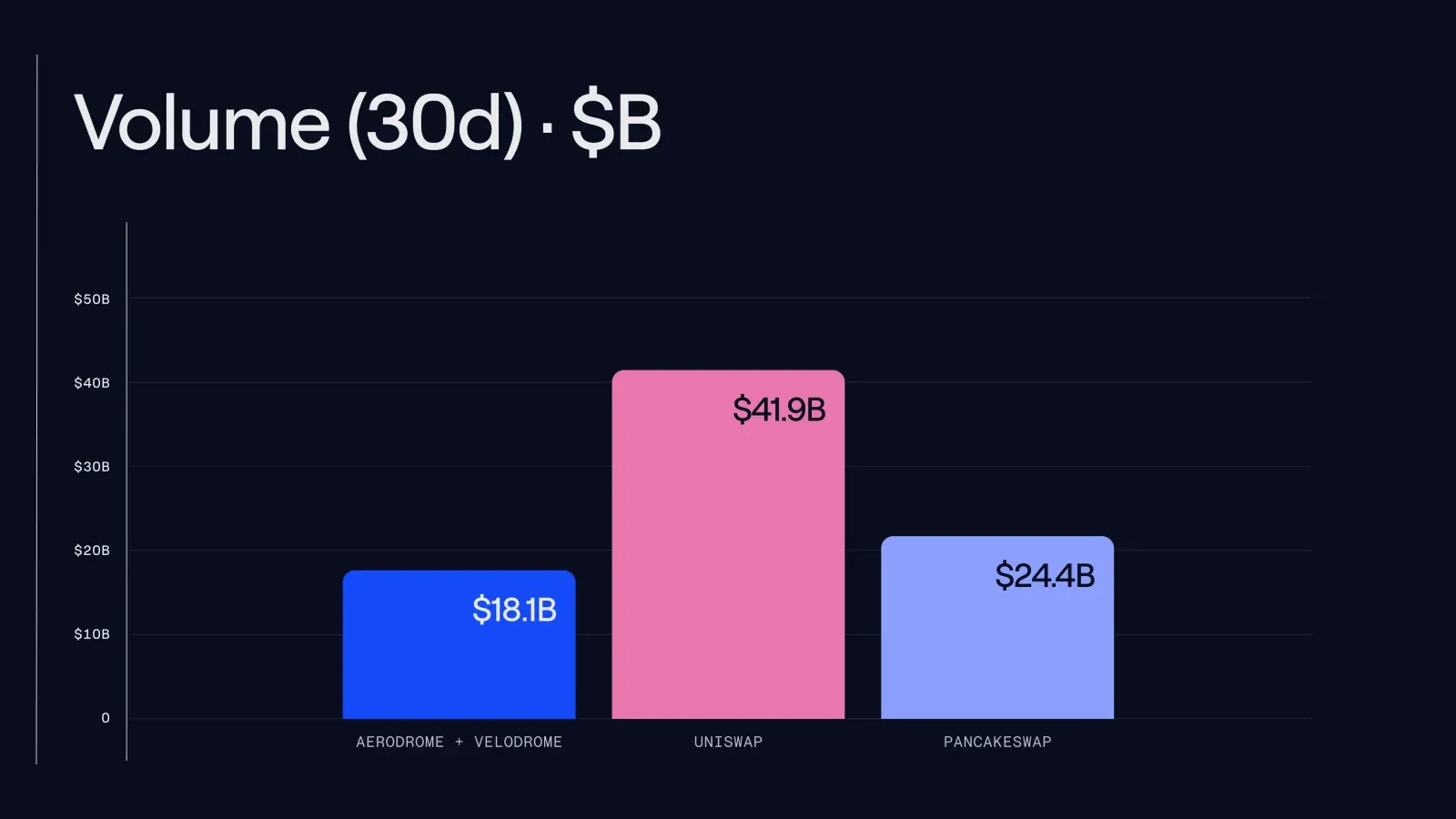
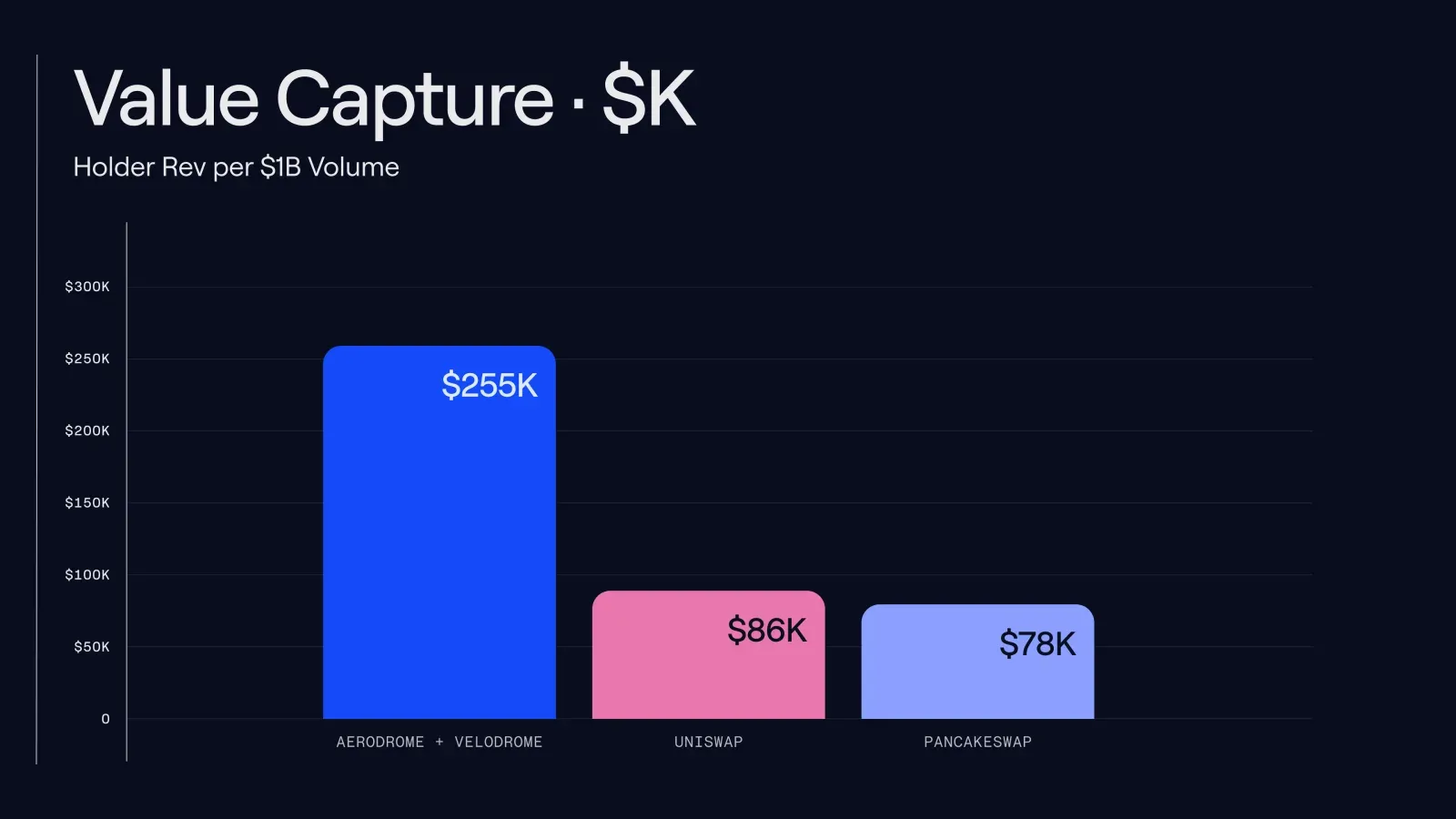
The thesis: an outsized amount of EVM volume and TVL sits in pools that generate relatively little value in the form of rewards for liquidity providers. And unfortunately across many of the leading pools on Ethereum Mainnet, liquidity providers have seen their share of the value they create slashed by up to 25% and redirected to entrenched legacy token stakeholder groups.
As we’ve seen repeatedly, liquidity providers are fundamentally value-maximizers that are willing to shift at a moment’s notice to a platform that rewards them better for their cost of capital.
And we will reward them better.
We won’t do so via the old methods of minting a fixed quantity of tokens and directing them to low-revenue pools that don’t justify the cost; rather, the protocol will direct even more value to the token via the REV Engine, turning it into a wrapper representing far more than just trading fees, increasing the premium over swap fees it already represents. At the same time, the first-of-its-kind AER Engine ensures that the system only mints what is needed to win.
That is how Aero becomes the largest exchange across every metric—revenue, volume, and TVL—with the momentum of onchain spot markets behind it. We win the markets worth winning, at the price they’re worth.