



The Aero Economy
TL;DR
- Aero launches October 21: an onchain spot exchange designed to serve as the unified liquidity layer for all of Ethereum
- Aero brings together Aerodrome and Velodrome—two DEXs that dominate their respective ecosystems—and extends a fully upgraded version of their winning exchange model to seven networks
- Aero is able to pay LPs more, giving them the option to earn AERO, a token that—when staked—is a claim on all sources of exchange revenue
- Aero is built to do three things:
- Win trading flow
- Network expansion increases market by ~4x
- Extending Aero’s proven ability to win high-value asset classes as they come onchain
- Programmable fee rebates can unlock more retail flow
- Active-tick rewards and market-responsive fee/revenue mechanisms improve capital efficiency, deepening liquidity to compound dominance
- Increase the value of that flow
- Upgraded dynamic fees + MEV tax increases fees/revenue on trades
- Fee-earning LPs can earn more on Aero with risk-adjusting smart fees and a 0-5% unstaked fee rate at launch
- AERO-earning LPs can earn even more, with a multiplier set to track 1.2x the value of revenue over time
- Optimize the underlying token economy
- Predictive Allocation leverages market dynamics to direct issuance to high-potential existing and emerging markets, even ahead of demand
- Gauge Caps track value of potential AERO rewards to projected revenue, preventing overspending and allowing rates to surge with volatility
- MinStake time keeps payments to useful liquidity
- The Momentum Fund is able to use market-aware buybacks to control supply, able to burn AERO and sAERO
- The REV Engine is set to introduce new revenue streams that don’t require new AERO issuance, increasing rev/token
- Unstaked fee can dial up over time, increasing revenue with dominance
- Win trading flow
- Long-term modeling shows how Aero is built to become more competitive and productive as it scales.
Key terms 16 definitions this piece leans on. Read them first, or jump back here from a term's first use.
Before we begin, here are the key terms this piece relies on. Each builds on the ones before it.
Participants
- Traders: anyone who swaps on Aero, from retail users to professional desks.
- Liquidity providers (LPs): deposit tokens into pools so traders have liquidity to trade against.
- Token Operators: stake AERO, direct rewards to pools and earn Exchange Revenue.
- Token Issuers: teams that launch and grow markets for their tokens on Aero.
Fees
- Trading Fees: the standard fee a trader pays on a swap. Every exchange charges them, and on most they are at best the ceiling for what an LP earns.
- Smart Fees: new with Aero, everything a pool earns from trades: Trading Fees plus, where switched on, a dynamic fee premium when markets move fast and an MEV tax on swaps that bid high priority fees. Programmable fee rebates are designed to let Aero charge registered aggregators, routers and desks less to win their flow. Other exchanges tend to offer one of these at a time, fragmenting liquidity across strategies. Smart Fees combine all three in one core product.
Positions
- sAERO: the position you get when you stake AERO for a period you choose.
- AERO-earning (staked) liquidity: LP positions staked to earn rewards in AERO. The Smart Fees they generate go to Token Operators.
- Fee-earning (unstaked) liquidity: LP positions not staked. They keep the Smart Fees they generate, minus any unstaked fee, a share of those Smart Fees that goes to Token Operators: 0% to 5% at launch, depending on the pool type and network.
Revenue
- Liquidity Payments: incentives Token Issuers pay Token Operators to direct rewards to a pool.
- Launch Payments: Liquidity Payments made to support a new token’s launch.
- Pool Revenue: everything a pool pays the Token Operators directing rewards to it: Smart Fees from AERO-earning liquidity, any unstaked fees, and Liquidity and Launch Payments.
- Service Revenue: fees from products built around the exchange rather than from trades in its pools, such as an sAERO marketplace, automated management tools and cross-chain swaps. All service revenue will return value to the token, mostly through buybacks and/or burns, without requiring more rewards for LPs.
- Exchange Revenue: the share of everything paid on Aero that the exchange keeps, across every pool on every network: Pool Revenue plus Service Revenue. It reaches beyond Smart Fees, and sAERO is the claim on all of it.
Rewards
- AERO Rewards: AERO paid to AERO-earning LPs, directed to pools by Token Operators and minted only when claimed.
- Gauge Caps: each pool’s AERO Rewards are capped at a multiple of its Pool Revenue with a long-run target of about 1.2x across the exchange. Caps adjust as markets move and distribute rewards on a variable basis, surging with volatility, paying less in calm times: allocation sets where AERO Rewards go, and the cap sets the most each pool can receive.
Revenue flows up to Token Operators and the token. AERO Rewards flow down to LPs.
Aero launches on October 21st.
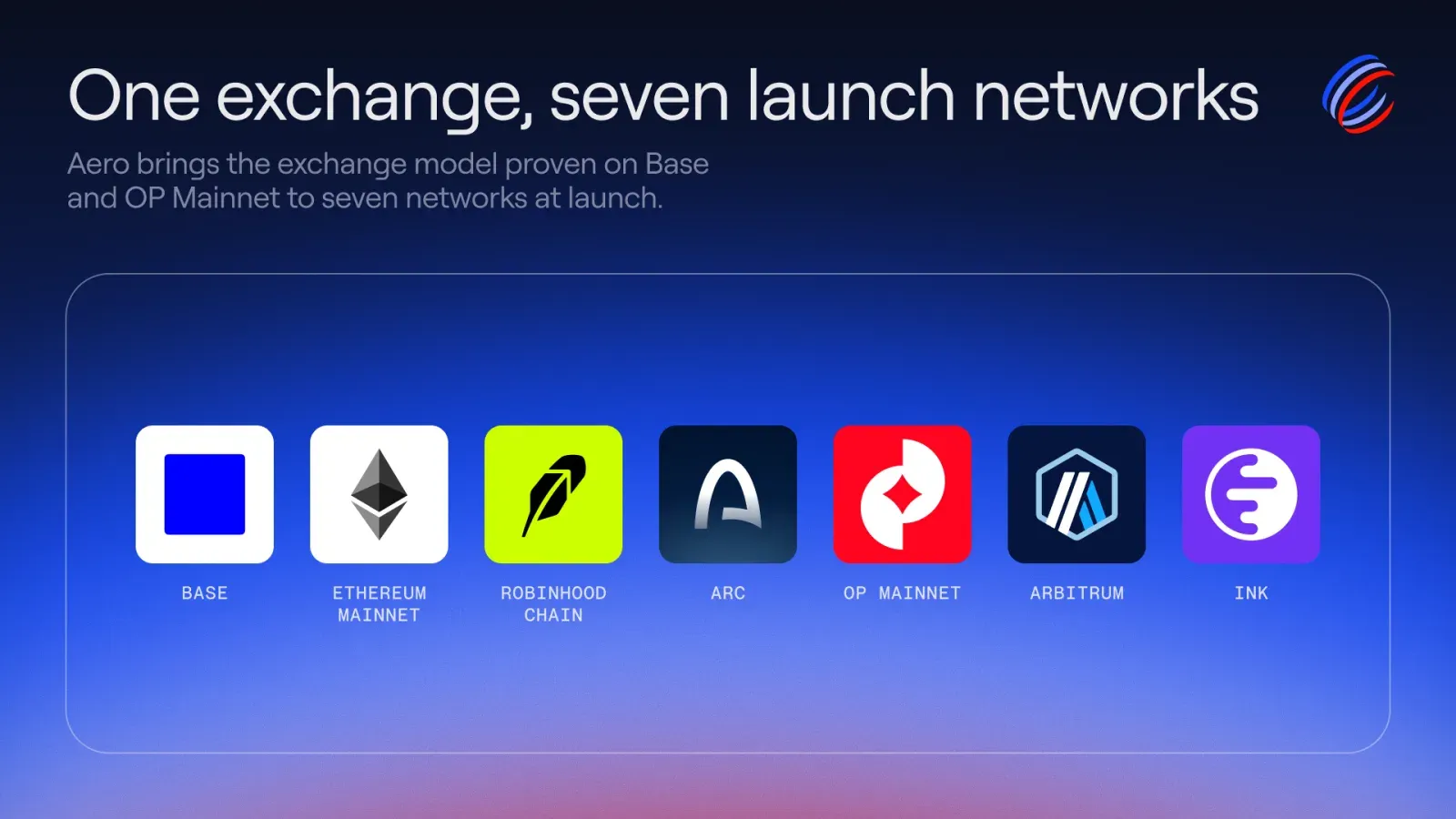
Built on the new MetaDEX03 architecture from Dromos Labs, Aero is a full upgrade of the exchange model that enabled Aerodrome and Velodrome to dominate their home ecosystems. It brings that model to more networks with nearly four times the DEX volume of Base and OP Mainnet.
The timing could not be better. More strategic assets and high-value markets are coming onchain just as the AMM model faces new threats. New execution technologies, such as Proprietary AMMs increasingly compete for retail flows. LP returns are compressing, making the structural ability to compensate them at a higher rate the competitive advantage for a DEX in this new era.
Aero is built for this moment.
It is designed to be the unified liquidity layer for Ethereum: serving strategic markets, helping bring more high-value assets onchain, and returning as much value as possible to its open network of participants.
That starts with generating more value to pay liquidity providers (LPs) more.
Paying LPs fairly is the problem every AMM-powered onchain exchange has to solve. LPs carry real costs to hold a position, and point-in-time fees don’t always cover them. As more strategic assets come onchain, AMMs will need to pay LPs for the full value of their liquidity, not just the fees of the moment. The ability to do so will decide who wins those markets.
Exchanges tend toward winner-take-most. Over time, LPs move to the venue that pays them best, and traders follow the depth they bring. As a pool becomes the dominant venue, more flow makes its liquidity more productive, earning more fees and making it harder for competitors to match its returns. The venue that pays enough to hold liquidity through changing conditions keeps the traders, and that position compounds.
Paying LPs fairly is a necessity for the industry and a competitive advantage for Aero.
Aero does this by paying LPs in a token that, when staked, is a claim on all of the revenue the exchange earns, not just block-by-block trading fees. That lets Aero reward each deposit for the value it adds to the whole network, and pay more than a venue that can only pass through its own fees.
It also solves what some have called the alignment trilemma. In most systems, contributors, investors, and LPs compete for the value coming in. When one token is the claim on all revenue, holding it is how anyone shares in Aero’s growth, so everyone is aligned behind it. And as builders, issuers and other partners hold sAERO, more people have a stake in bringing assets, liquidity and users to Aero.
We’ve covered many of Aero’s features in earlier pieces. Today, we want to show how they fit together in one economic model, built to dominate onchain spot trading as tokenization accelerates.
That model has three parts, and everything Aero does serves one or more of them:
- Win the flow: trading activity, especially for strategic markets and high-value asset classes.
- Increase the value of that flow: raising fees when sustainable and adding new revenue streams.
- Optimize the token economy that enables it: managing supply and controlling dilution over time.
Each part strengthens the others. Competitive rewards attract liquidity that helps Aero win flow. Earning more from that flow lets the protocol sustain those rewards with less new token issuance. Growth strengthens the economics, and stronger economics funds more growth.
For anyone wanting to go deep on things like Gauge Caps, market-aware compensation rates, dynamic fees, active-tick rewards, MinStake time, the Momentum Fund, and more: this is for you.
1. Win the Flow
Winning flow starts with expansion.
At launch, Aero will deploy across seven networks: Ethereum Mainnet, Base, Arbitrum, OP Mainnet, Ink, Arc, and Robinhood Chain. Every network will receive a full deployment, with AERO Rewards directed across the network through Predictive Allocation.
When the launch was announced, the networks served by Aerodrome and Velodrome carried about 17% of EVM spot trading volume. By mid-October, the seven launch networks were handling nearly four times the DEX volume of Base and OP Mainnet. That gives the protocol far more room to grow, on top of the growth of onchain activity itself.
And the assets moving into these markets are changing.
Stablecoins, at over $300 billion in market capitalization, already show the scale financial assets can reach onchain. Tokenized equities are following. In 2026 alone, they have roughly quadrupled, from about $0.84 billion to $3.5 billion. Yield-bearing assets such as tokenized Treasuries total about $14.7 billion across products, and they are building blocks for onchain savings, collateral, and portfolio management. The room to build liquid markets around these assets grows with their adoption.
Aero’s expansion brings it closer to this capital. As eligible assets become available for trading and integration, they need dependable liquidity, competitive execution, and connections to the rest of the onchain economy. Predictive Allocation can help liquidity flow with demand, or even in anticipation of it. Slipstream V3 can make it more productive. Metaswaps will extend its reach across supported networks.
This gives Aero two sources of growth at once: winning a greater share of the markets that already exist, and helping build entirely new markets onchain.
Winning these markets means making Aero the best place to supply liquidity. LPs need fair, competitive returns, traders need competitive execution, and new assets need liquidity deployed efficiently, at the lowest cost, before they have established trading histories.
Aero’s architecture connects all three.
More productive liquidity: Slipstream V3
Slipstream’s success has come from capital efficiency: more volume, more fees, and less slippage per dollar of TVL. Two features explain most of that efficiency. AERO Rewards go only to liquidity in the active tick, the price range where trades execute, so rewards pay for depth that traders actually use. Dynamic fees then price that depth for market conditions.
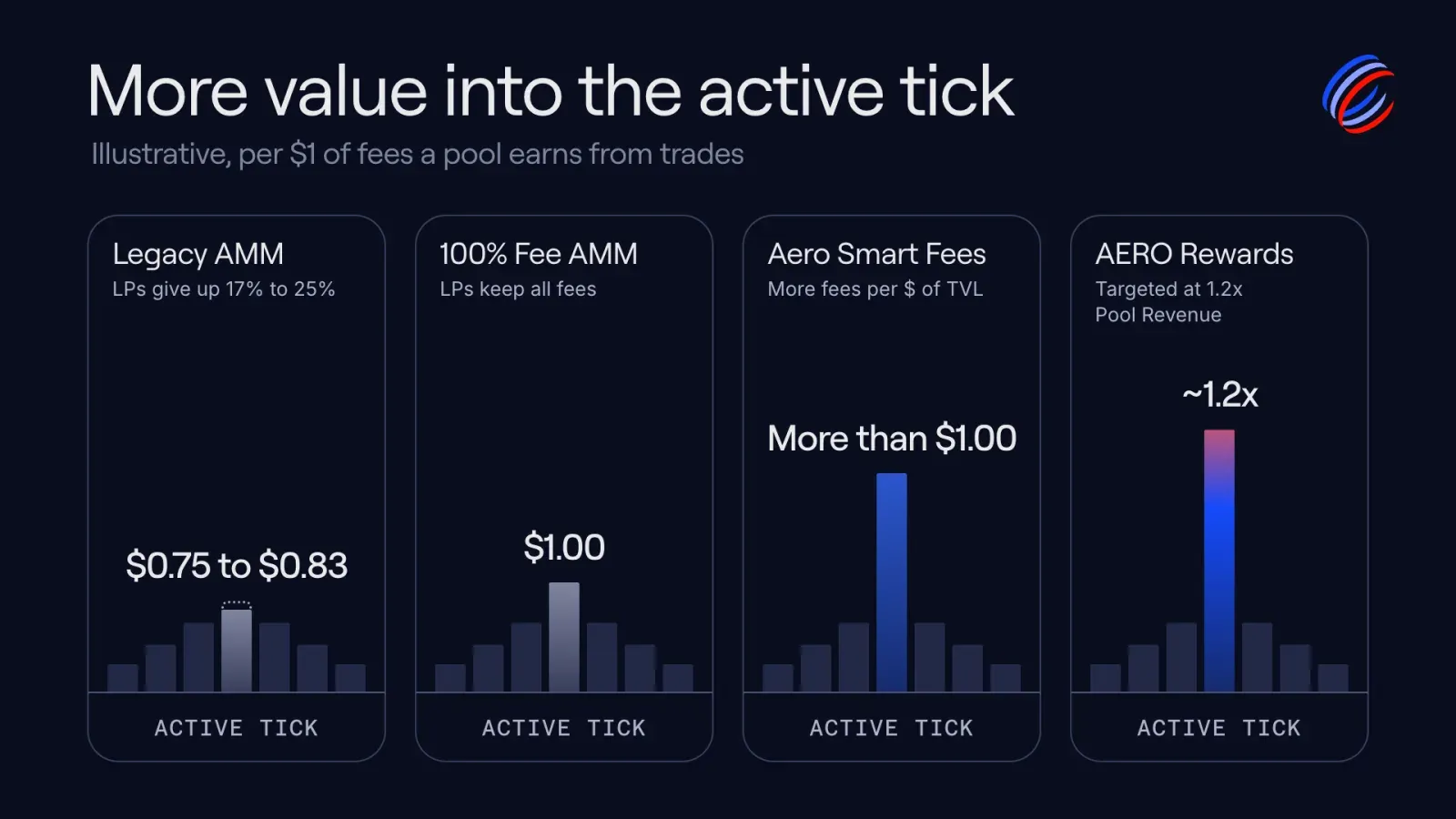
Efficiency helps new pools become useful with less capital and helps established pools attract more flow. For LPs, it means their deposits can support more activity. For traders, it means better execution.
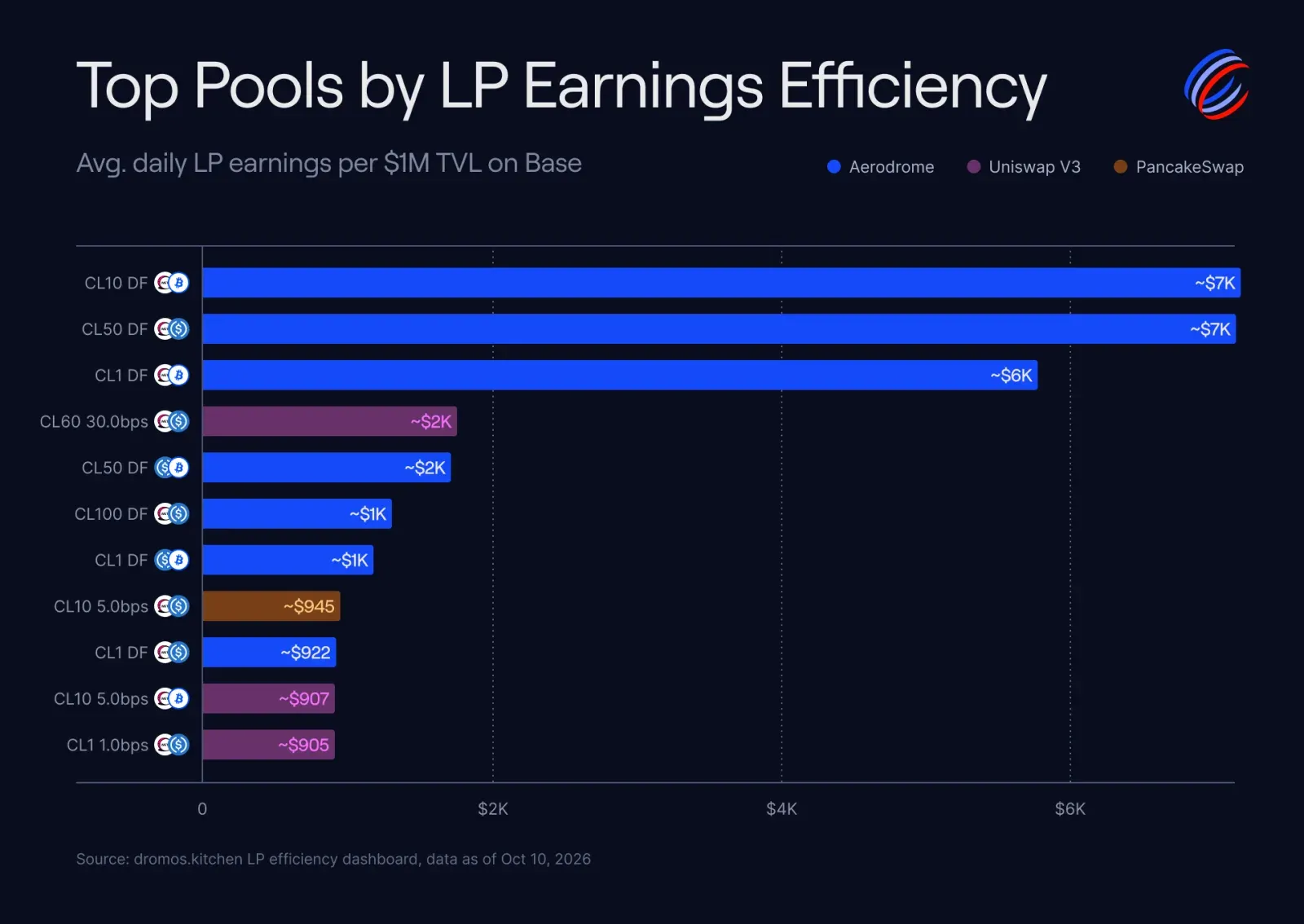
Slipstream V3 adds more precise fees and new fee sources for pools, designed to bring what LPs earn closer to what it costs them to provide liquidity. But its role in winning flow starts with the same principle that made Slipstream successful: make each dollar of liquidity more productive.
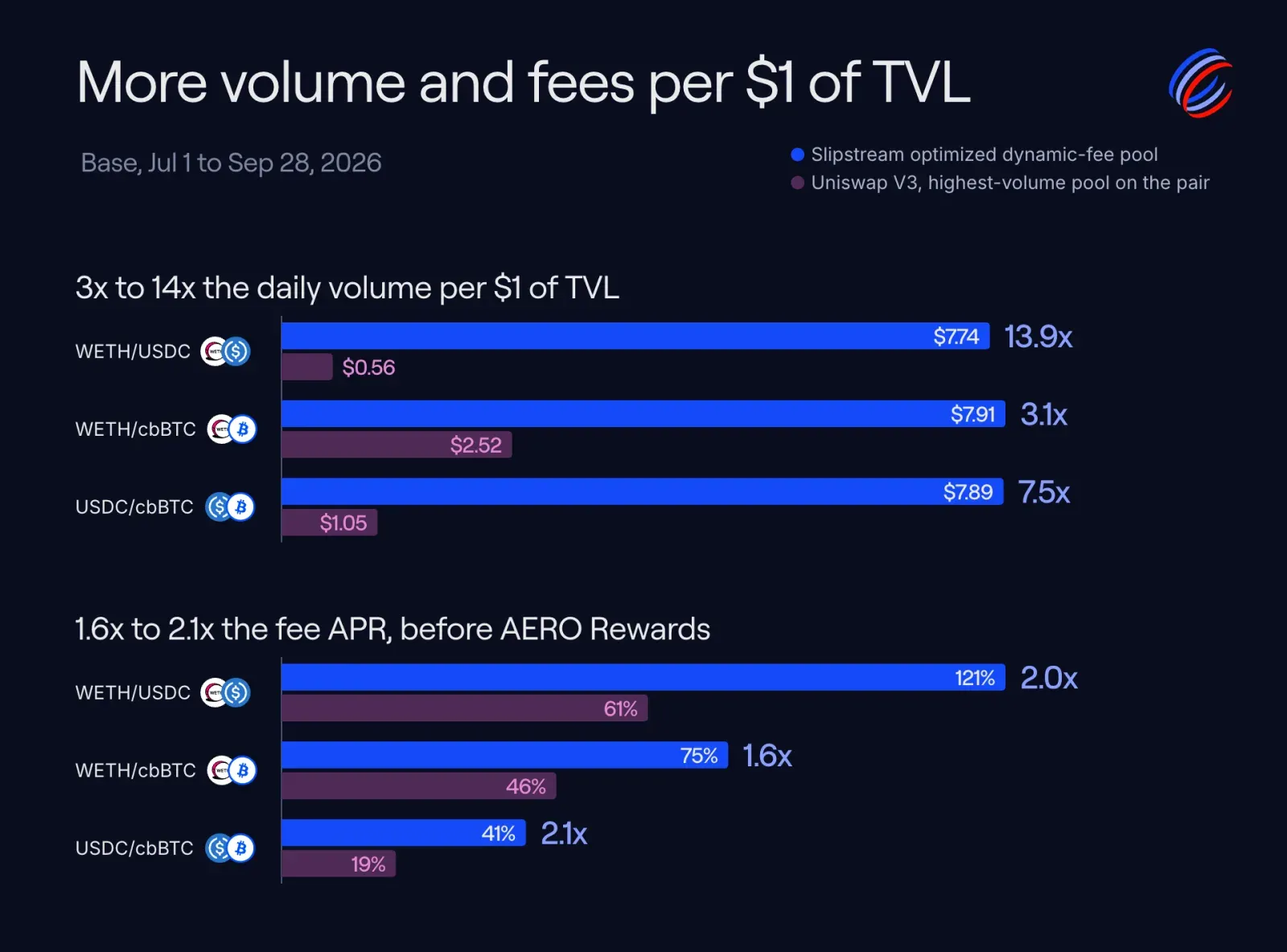
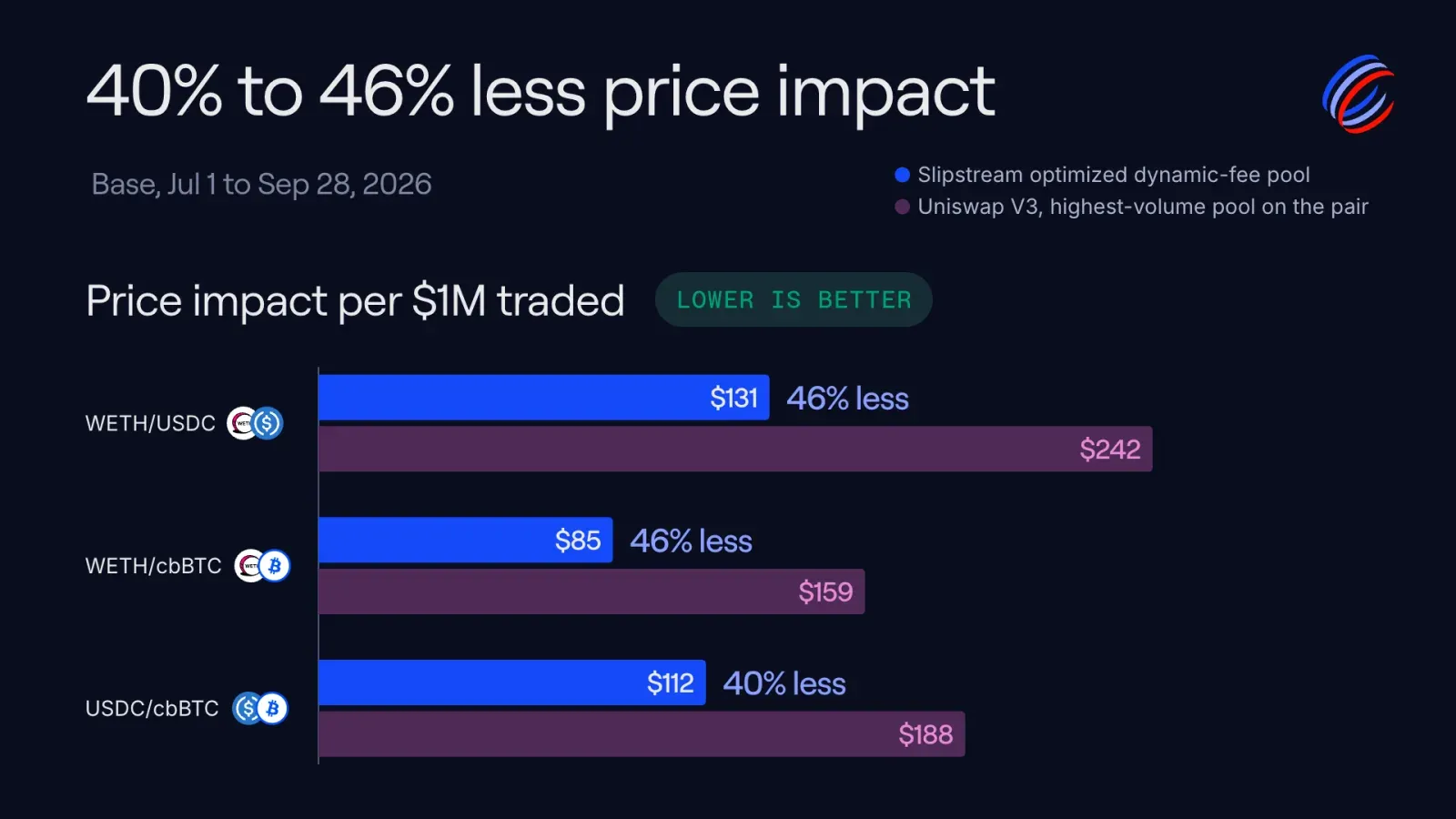
On Base from Jul 1 to Sep 28, 2026, Slipstream’s three optimized dynamic-fee pools on Aerodrome traded 3x to 14x more volume per dollar of liquidity than Uniswap V3’s highest-volume pool on each pair. They had 40% to 46% less price impact per $1M traded and earned 1.6x to 2.1x as much from trades per dollar of liquidity, before AERO Rewards.
Competing for retail flow
Slipstream V3 also gives Aero more ways to attract valuable trading activity.
As in any financial market, verifiable retail flow on Aero generally carries less adverse-selection risk for LPs than flow from informed traders and arbitrageurs. So Aero can charge retail traders less while the pool still earns attractive fees.
Programmable fee rebates, the third part of Smart Fees, are designed to let Aero charge registered aggregators, routers and desks a lower fee on public, auditable terms, so it can compete with new tech like Proprietary AMMs for that flow.
The aim is to match the cost of trading more closely to the cost of serving it, and to win more of the flow that improves these markets.
Making new markets easy to enter
Aero’s goal is to dominate the markets it enters, and that means being the best venue for all LPs, including those who prefer to earn fees directly. These LPs can help establish liquidity on new networks and in new pairs while Token Operators begin directing AERO Rewards to those pools.
At launch, fee-earning liquidity will receive promotional unstaked fee rates:
- 0%: Ethereum Mainnet, Arbitrum, and Robinhood Chain.
- 5%: Arc, OP Mainnet, Ink, and Base.
On the largest competing venue, LPs get point-in-time Trading Fees, and they give up 17% to 25% of those to platform fees. On Aero, LPs who earn fees keep 95% to 100% of Smart Fees at launch. Smart Fees are Trading Fees plus, where switched on, a dynamic fee premium and an MEV tax. So LPs on Aero keep a bigger share of a bigger fee base.
That means an LP who never stakes can earn more on Aero than an LP who keeps 100% of Trading Fees elsewhere, even after the 5% unstaked fee.
These rates prioritize adoption. Earning fees directly is familiar to LPs who don’t yet know Aero’s reward system, and a low cost of entry makes it easier for them to move. Every LP who arrives deepens the market for the next trader and the next LP, so each market Aero wins gets harder to compete for.
As pools deepen and become dominant venues, the unstaked fee can rise while still beating competing venues. A higher unstaked fee makes AERO-earning liquidity more attractive, shifting more liquidity to staking, where all of its Smart Fees go to Token Operators.
2. Increase the Value of That Flow
Winning flow is the foundation. Earning more from that flow strengthens everything built on it.
On Aero, that starts with Smart Fees.
Every swap pays Trading Fees, and Smart Fees add two things on top where they are switched on: a dynamic fee premium when markets move fast, and an MEV tax on swaps that bid high priority fees. Both additions raise what the same trade earns, so LPs and Token Operators get more from the same volume.
Dynamic fees: better pricing as markets change
The first step to paying LPs fairly is compensating them correctly when their costs are highest. The dynamic fee is the part of Smart Fees that prices market demand for liquidity: a fee that is competitive in calm conditions undercompensates LPs during volatility, and one set for volatility discourages trading when markets are quiet. Traders behave differently in each: when markets move fast they care more about getting filled than about the fee, and when markets are calm they shop for the lowest price.
Slipstream’s dynamic fee framework has evolved around that relationship. Its first phase let pool fees vary with the assets being traded. Its second added higher fees during volatility.
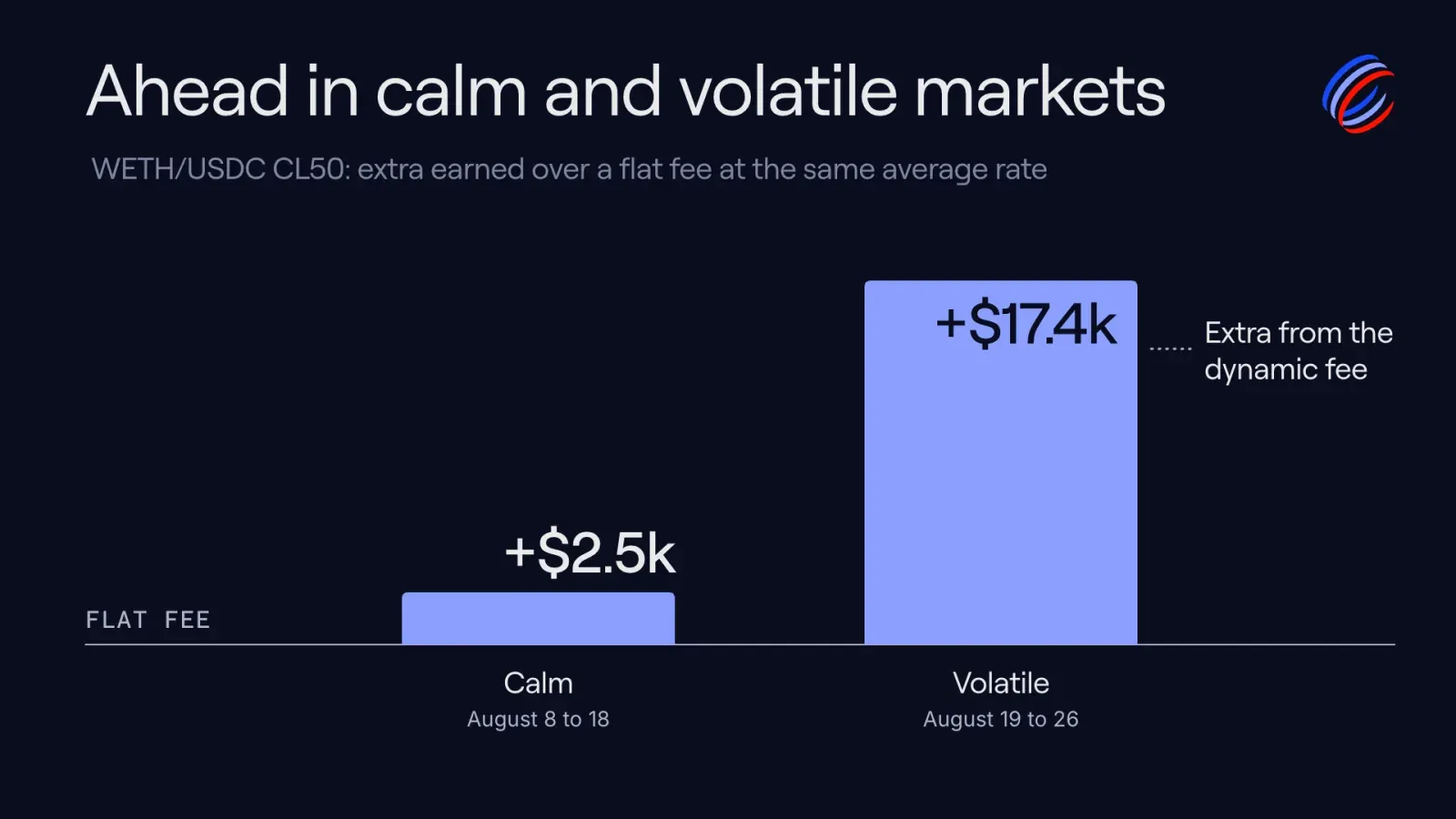
Aero launches with an optimized dynamic fee algorithm, calibrated after almost a year of research to earn more when liquidity is most valuable. Backtesting the same swaps against flat-fee alternatives shows the benefit of adapting to market conditions. Against a flat fee set at the same average rate, the dynamic fee earned more in all nine pool-windows tested: three pools across calm, volatile and post-volatility periods in August and September 2026. On WETH/USDC CL50 it earned $2.5k more in the calm window (Aug 8 to 18) and $17.4k more in the volatile week (Aug 19 to 26).
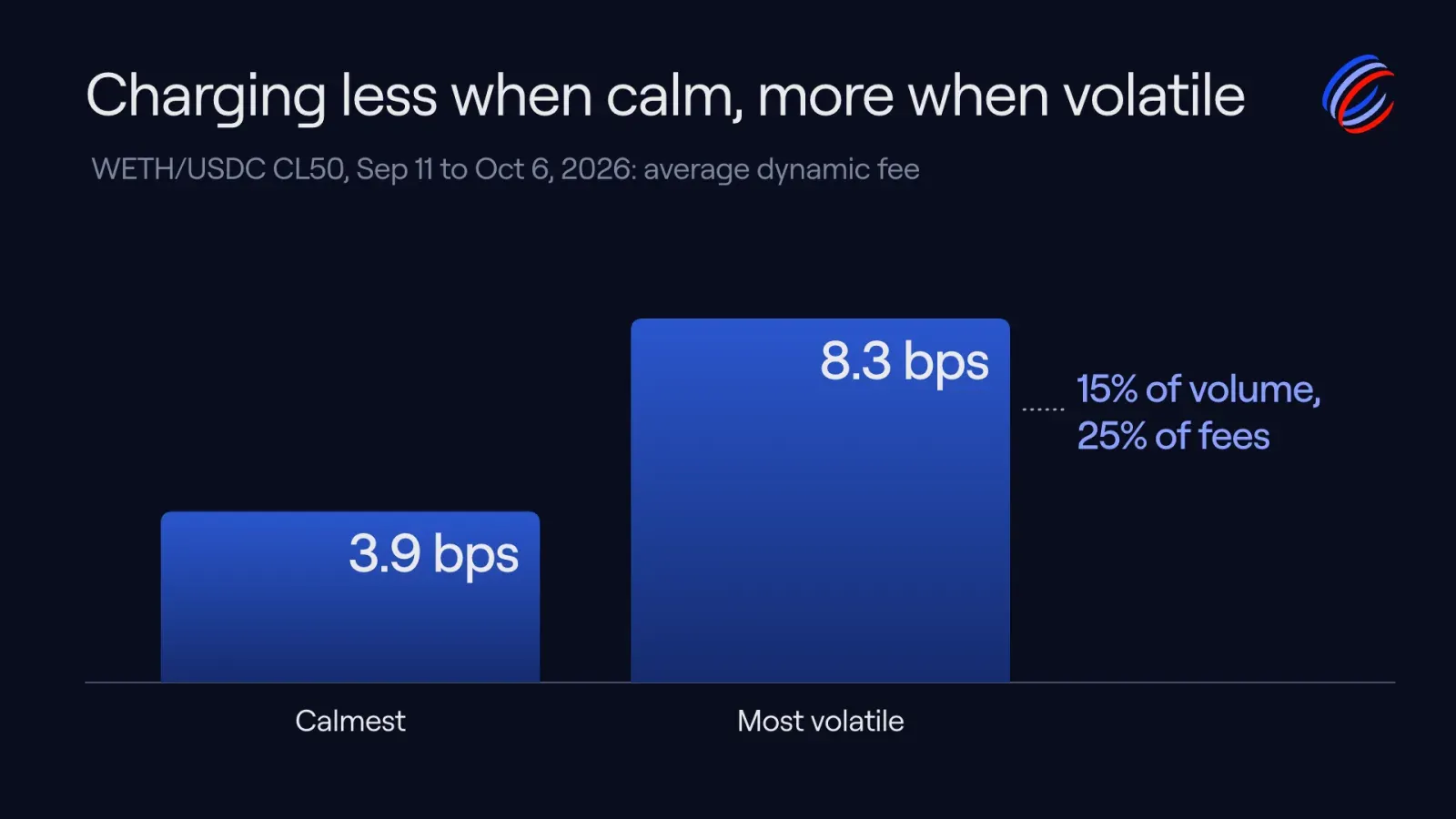
What explains this value differential? On WETH/USDC CL50 the dynamic fee charged an average of 3.9 bps in its calmest periods and 8.3 bps in its most volatile. The most volatile periods produced 15% of the pool’s volume and 25% of its fees (Sep 11 to Oct 6, 2026).
The framework is designed to add optimizations for different pools, asset types, and market conditions. Slipstream V3’s modular design lets future upgrades apply to existing pools, so LPs don’t have to migrate and liquidity doesn’t split across versions. The deepest, most-traded pools get the new pricing live as optimizations occur.
As Aero wins more flow, more trades are priced for the conditions they happen in: LPs are paid fairly when markets move, and traders pay less when they are calm.
MEV tax: capturing the value of urgency
Paying LPs fairly means paying them for the risk they carry, and much of that risk comes from informed traders and arbitrageurs. Like high-frequency traders in traditional markets, they profit by acting first, trading against a pool’s stale price at LPs’ expense. Onchain, though, they leave a fingerprint: the priority fees they pay reveal when they act and how much a swap is worth to them.
They pay priority fees to execute before other transactions. Historically, that payment has gone entirely to sequencers, even though the trade depends on LPs’ liquidity.
Aero’s MEV tax module lets pools capture part of that value.
When a swap’s priority fee exceeds a threshold associated with typical retail activity, the pool charges an additional fee that rises with it. Swaps below the threshold pay nothing extra. The tax is the second addition to Smart Fees and is split like the rest of them: to fee-earning LPs, minus the unstaked fee, or to the Token Operators directing rewards to the pool when the liquidity is AERO-earning.
The tax targets one kind of transaction: competitive arbitrage that bids high priority fees. Typical retail swaps and ordinary tips are untouched, and the sequencer still receives every priority fee it is paid. What changes is who shares the arbitrage margin. Today, on the largest arbitrage trades, much of it leaves the ecosystem while LPs absorb the cost. Returning part of it to the LPs whose liquidity made the trade possible, or to Token Operators, deepens liquidity. Deeper liquidity tightens execution and brings more volume to the network, so the chain hosts a larger market.
Tens of millions of dollars have been spent on priority fees for Aerodrome transactions. Aero lets more of the value around those transactions return to the network that enables them.
The module will roll out gradually and expand based on results. We expect the largest gains in the deepest, most actively traded pools, where competition for priority is strongest.
Together, the dynamic fee premium and the MEV tax raise Smart Fees per dollar of liquidity. That is what lets Aero pay LPs more while giving Token Operators more to earn.
3. Optimize the Token Economy
Smart Fees increase the earnings from each trade, but much of what Aero pays LPs comes in AERO.
Every exchange pays for its liquidity somehow. What matters is who pays and who gets paid. Exchanges that pass 100% of trading fees to LPs can look free, but someone still covers what it costs to build and run them, often hundreds of millions of dollars in token unlocks and treasury spending.
On Aero, that cost is issuance. Paying LPs in AERO means issuing new tokens: every AERO Reward is newly minted AERO, and each new token spreads the exchange’s revenue across a larger supply. That cost is also Aero’s edge. Issuance turns the network’s future revenue into pay for LPs today, which a venue limited to its own fees cannot do. It also shifts ownership from holders who sit still to the LPs and Token Operators who grow the network.
Done well, as Dromos Labs wrote in On Issuance, it “grows the pie” instead of slicing it thinner. And because Aero sets rewards as a dollar budget, a higher AERO valuation means fewer new tokens for the same pay. Done badly, issuance outpaces revenue and every token’s claim shrinks. So the rest of the system is built to keep it tied to value, in three ways:
- Direct issuance where it earns the most. Predictive Allocation, where Token Operators direct rewards ahead of demand, replaces a weekly vote on last week’s fees, which could keep paying a pool that had stopped earning. Active-tick rewards and MinStake time pay only for liquidity that stays useful.
- Slow the rate of dilution. Gauge Caps tie rewards to what each pool earns, replacing a fixed schedule and a weekly rebase, and Momentum Fund buybacks and burns take supply back out.
- Grow revenue that doesn’t depend on issuance. Liquidity and Launch Payments bring in outside money, and the unstaked fee and Service Revenue from the REV Engine can add revenue without raising Gauge Caps.
The goal is revenue per token that rises over time, while Aero keeps paying LPs fairly. The sections below cover each one.
Predictive Allocation: bringing liquidity ahead of demand
Providing liquidity is an act of anticipation. Some of the most valuable liquidity arrives before a market is established.
A strategic asset may need deep liquidity before institutions can use it. A new pair may need dependable execution before applications integrate it. A new use case for LP positions may need scale before it becomes viable.
Getting liquidity where it is needed, when it is needed, is a hard problem. It is risky for LPs to take on alone, and costly for issuers, ecosystems and exchanges to manage themselves. It is also a core problem in financial markets. New markets often fail to get off the ground, or go illiquid in volatile periods. Predictive Allocation creates a new market mechanism to tackle this problem. Token Operators compete to anticipate demand, and those who anticipate it well earn more. A market-based approach puts more knowledge to work than any single team or model could.
Predictive Allocation lets sAERO coordinate that initial capital, often alongside Liquidity and Launch Payments that a token’s issuer streams to the Token Operators allocating to its pool.
Token Operators direct AERO Rewards toward pools they expect to generate future Pool Revenue, so issuance goes where it is expected to earn the most. Those rewards give LPs a reason to deploy capital, while the allocation itself signals where demand may emerge.
This makes Predictive Allocation a new primitive, it rewards Token Operators for giving LPs a useful market signal. LPs receive a clearer stream of compensation for providing the liquidity to serve it. The net effect can improve the core economics of providing liquidity.
The resulting depth can improve execution and attract more volume, so the market can grow into what Token Operators anticipated. As it grows, it earns the network more revenue.
Aerodrome has done this before: when cbBTC launched, Coinbase Ventures and the Aerodrome Foundation used their veAERO positions to seed liquidity rewards early, and cbBTC trading on Base grew to about $12 billion a month at its peak.
The same mechanism helps established markets.
Suppose a tokenized stock’s pool has been quiet ahead of the company’s earnings call. A Token Operator who expects trading to pick up can shift allocation to that pool in advance. LPs can see the shift and deposit, knowing that if trading surges and the pool’s Gauge Cap rises with it, AERO Rewards are already allocated to fill it. Token Operators who moved early hold a larger share of that pool’s allocation when trading arrives, so they earn more of its Pool Revenue. Depth arrives with demand rather than after it.
The payoff: new markets open with deep liquidity, and the LPs who arrive early are paid for the market they help build, not just the trades of the moment.
Gauge Caps: a market-aware compensation budget
AERO Rewards are streamed to LPs in real time through a pool’s “gauge.” That gauge calculates the rate of rewards based on how much allocation weight is assigned x the minter’s base rate.
The realized rate of rewards for LPs is also influenced by a new mechanism: a Gauge Cap.
Each pool dynamically projects future revenue and then adjusts the rate of possible rewards at a multiplier of that revenue, denominated in dollar value.
These caps set the maximum rate of rewards accordingly, which prevents unnecessary minting of AERO because the AERO held back by the cap is never distributed.
Gauge Caps also allow for something equally important: the ability to surge rewards rates with volatility.
As market signals warrant, a Gauge Cap can quickly adjust up to allow for a higher rate of rewards. Assuming Token Operators have pre-allocated sufficiently, this means LPs will be able to earn more in these moments.
System-wide, this allows dilution to temporarily increase when backed by opportunities to earn revenue before returning to baseline.
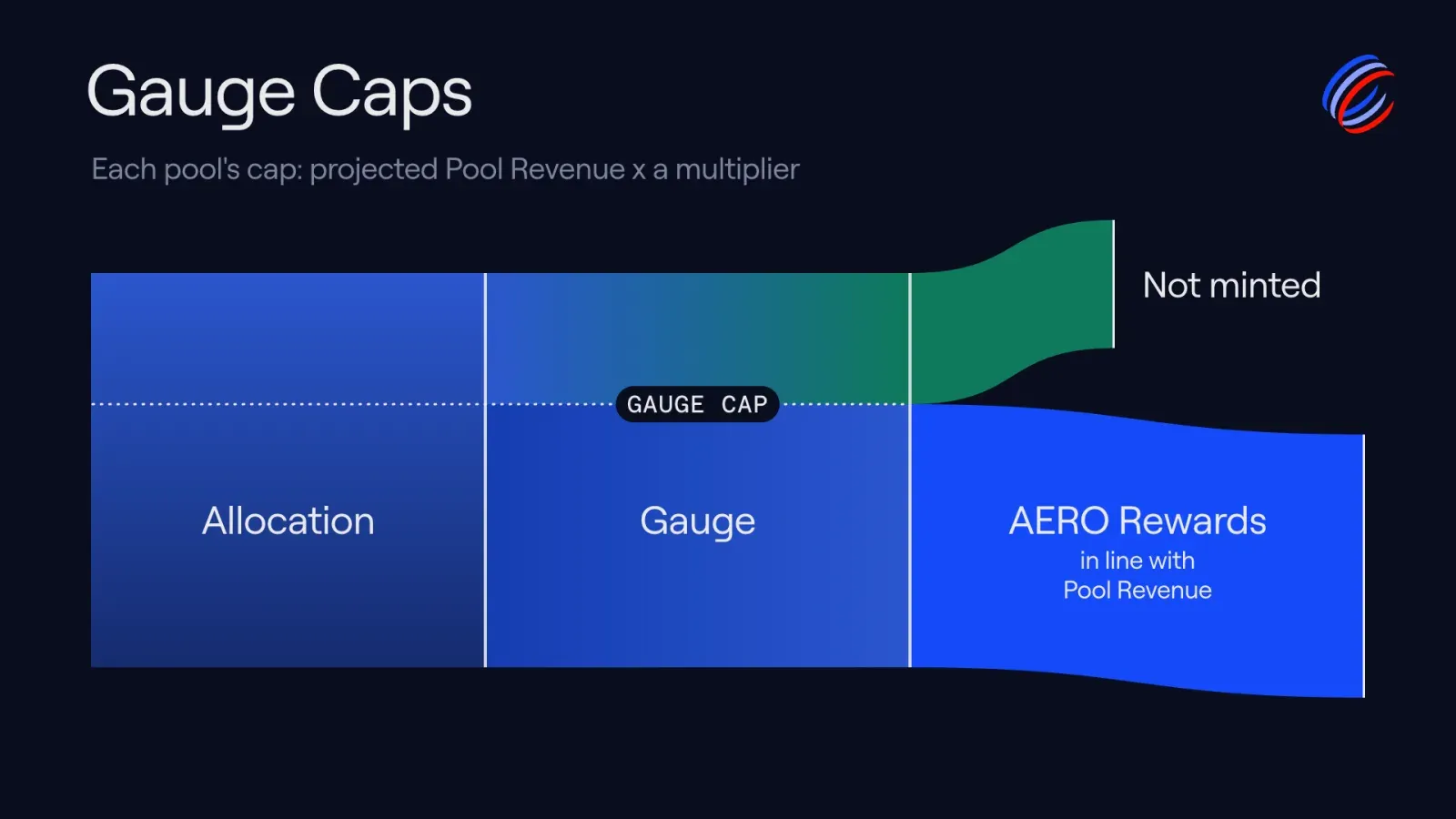
The long-term target is for AERO Rewards to be worth about 1.2x Pool Revenue on average across the exchange. Because Pool Revenue includes Smart Fees, with their dynamic fee premium and MEV tax, a pool that earns more per dollar of liquidity pays its LPs more at the same multiple.
Individual pools can sit above or below that target as competitive conditions change.
This lets Aero keep a premium over Smart Fees for LPs while controlling what that premium costs in dilution. Strategic assets can get more support without the same premium on every pool.
The objective is to fund the liquidity that earns the premium, at a rate that fits its market.
Active-tick rewards and MinStake time: paying for liquidity that stays useful
Aero rewards liquidity for time spent in the active tick, even when that liquidity is not immediately used by a swap.
Available liquidity has value before a trader arrives, and rewarding it helps Aero prepare for future trading.
MinStake time ties those rewards more closely to useful liquidity. Without it, faster blocks would let bots add liquidity for milliseconds, collect rewards and leave before a volatile move.
LPs who withdraw before the minimum staking period forfeit their rewards, which are never minted, so they are effectively burned. This is designed to stop LPs from collecting rewards briefly and leaving before the periods when liquidity is most needed.
The minimum duration is calibrated to asset type and market conditions. Shorter positions can be useful in highly active markets. Less frequently traded assets may benefit from longer commitments, keeping liquidity available until demand arrives.
Together, active-tick rewards, responsive Gauge Caps, and MinStake time let Aero pay for available liquidity while directing more of its budget to LPs who stay useful as conditions change.
Earning more as markets mature
For LPs, there is strength in depth. As pools deepen and become the dominant venue for their pairs, LPs gain pricing power and Smart Fees earn more per trade. The unstaked fee balances what fee-earning and AERO-earning LPs take home as that happens.
At first, a low unstaked fee attracts fee-earning LPs who would be taxed on competing platforms or left in fragmented markets. As a pool matures, the fee can rise to reflect the value of that depth and the Smart Fee mechanisms. That adds revenue for the Token Operators directing rewards to the pool without new issuance, and it makes AERO-earning liquidity more attractive, so more LPs switch to earning AERO.
However LPs choose to be paid, pool depth grows, and so does the Pool Revenue that reaches Token Operators.
The Momentum Fund: buybacks that offset issuance more effectively
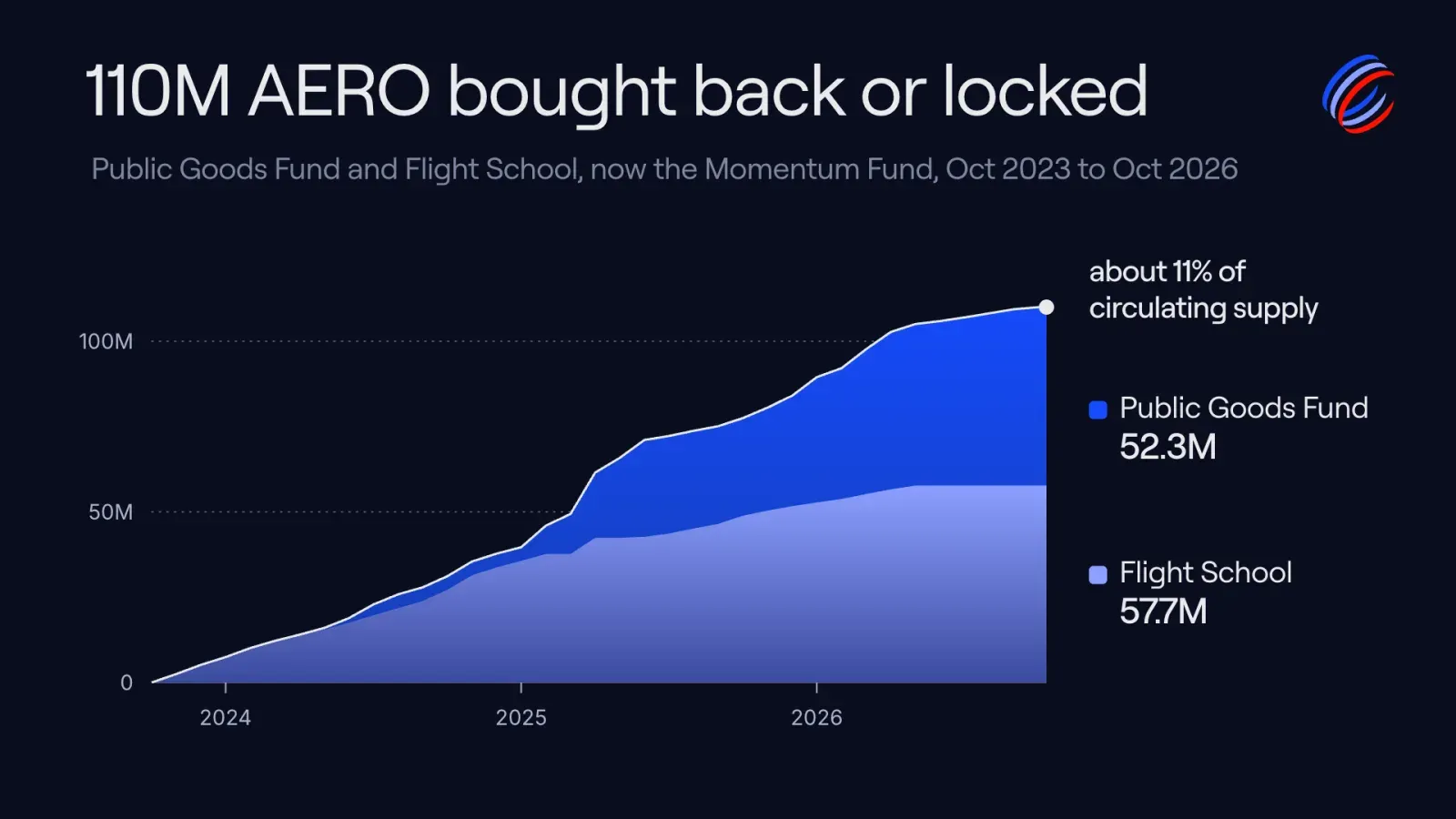
The Momentum Fund’s predecessors, the Public Goods Fund and Flight School, have bought back or locked about 110 million AERO, about 11% of circulating supply. Across all of Aerodrome’s buyback and lock programs, the total is about 180 million AERO, about 18%. Those buybacks and locks helped counter dilution from the protocol’s early growth.
With Aero, the strategy evolves. Gauge Caps already tie issuance to revenue, so the Fund’s job shifts to limiting total supply growth while preserving market share. It brings the Public Goods Fund and Flight School together under three mandates:
- Grow: directs AERO Rewards toward strategic pools and new assets.
- Stabilize: a share of the revenue the Fund earns can go to buy back AERO and manage supply depending on market conditions.
- Align: offers builders a share of the stable value sAERO generates to add more value back to the network.
The Fund pays for this from revenue it earns: the Fund holds one of the largest sAERO positions, so it earns Pool Revenue like any other Token Operator. The Aero Foundation runs the Fund and can hold that revenue in reserve, spend it on buybacks, or share part of it with builders through Align, keeping its options open as markets change.
A buyback on a fixed schedule would spend the same amount whether AERO is cheap or expensive, and its predictability would let other traders buy ahead of it. The Momentum Fund is market-aware instead. It builds reserves when markets are strong and is designed to deploy more of them when markets weaken and AERO trades at a discount to its historical range, when each dollar buys more AERO.
The Public Goods Fund has already tested this approach. Starting in October 2025, it ran the market-aware model as a pilot and bought 8.7 million AERO over 13 epochs. As volatility peaked, its weekly purchases reached the equivalent of 27.5% of that week’s AERO issuance and stayed above 20% for several weeks.
AERO the Fund buys back can be burned, which removes supply without diluting other holders’ revenue share. The Fund can also burn sAERO, whether bought from holders who want to sell or already held. That destroys the AERO inside along with its claim on revenue, so the Pool Revenue that position would have earned goes to the sAERO holders who remain. When sAERO trades below the AERO inside it, each dollar removes more supply.
“How It Comes Together” below shows what burns do to supply.
The REV Engine: revenue that doesn’t need new issuance
The REV Engine is designed to add Service Revenue that can be generated without the need for new issuance. This is because it utilizes the liquidity that has already been paid for and the ecosystem that grows around around it.
Examples:
- Using sAERO. An sAERO marketplace and automated management tools could charge fees, collected as sAERO and burned.
- Moving across networks. Aero can add a fee to Metaswaps beyond what covers fixed costs, and that additional fee could be used for AERO buybacks and burns.
- Building on Aero. Over time, teams can build their own products on Aero’s liquidity. A liquidity manager, for example, could charge its fee in AERO and burn part of it. Builders who hold sAERO have a reason to do this, because growing the network’s revenue grows their own stake.
Generally, early pricing for internally developed products and external partnerships will focus on growing adoption. The goal is for revenue to grow with the number of ways people use the network, without each new dollar earned as Exchange Revenue requiring more AERO Rewards.
That makes the REV Engine a competitive advantage, enabling lines of business that earn revenue without requiring more LP pay, which competitors cannot draw on when they try to outpay Aero. A competitor can subsidize liquidity, but it cannot easily copy the revenue, relationships and alignment of an established network.
Landing the Plane: How It Comes Together
Aero’s objective is to increase revenue earned per token over time, while continuing to pay LPs what it takes to be the dominant liquidity hub.
The opportunity starts with a larger market. More networks, strategic assets, and uses for liquidity create more flow to win. Competitive LP compensation and better execution help capture that flow, while Slipstream V3 increases what each dollar of liquidity can earn through dynamic fees and the MEV tax.
As Aero grows, it can earn revenue beyond Smart Fees. Liquidity and Launch Payments bring outside capital onto the platform, and deeper, more established markets will capture a greater share of Smart Fees earned by fee-earning LPs. The REV Engine creates opportunities to build new lines of business around the platform, adding revenue sources beyond trading that don’t depend on incremental LP pay.
Meanwhile, Gauge Caps and MinStake time make liquidity compensation more efficient, while Momentum Fund burns can offset part of the resulting issuance. Together, these mechanisms are designed to make Aero more competitive as it grows, while increasing revenue relative to the token supply.
The critical relationship is between the revenue Aero earns and what it must pay to attract liquidity. AERO Rewards are tied to Pool Revenue, but Exchange Revenue also includes Service Revenue, which needs no extra rewards. Liquidity and Launch Payments count toward Pool Revenue, so they raise Gauge Caps like any other revenue.
The unstaked fee and Service Revenue add revenue without raising them at all.
This creates an opportunity for revenue to grow beyond the cost of the premium Aero pays LPs. Aero does not need to reduce that premium to improve its economics; it can earn more revenue without incrementally increasing rewards.
Aerodrome already shows this. Over four weeks in September 2026, revenue to veAERO holders directing rewards reached $14.9 million: $6.1 million of trading fees passed to them, along with $8.9 million of Liquidity and Launch Payments. That was more than the $10.5 million of AERO paid to LPs over the same period, under the old fixed schedule.
For sAERO holders, the math works at today’s staking levels. sAERO is about half of AERO’s supply but receives all Pool Revenue, so with rewards at 1.2x the revenue it earns exceeds the dilution it absorbs.
Three things make this work:
- Issuance responds to value: a higher AERO valuation means fewer new tokens for the same rewards.
- Burns lower the rate: buybacks and burns take supply back out, lowering how fast revenue has to grow.
- A larger market raises revenue per token: more networks, assets and products give revenue more room to grow.
Issuance that responds to value
Gauge Caps also change how token valuation affects supply.
Under a fixed release schedule, the number of tokens issued stays constant while their dollar value changes with the market. Aero instead lets issuance vary within a capped range and ties reward value more closely to pools’ expected Pool Revenue.
When a cap is binding, a higher AERO price means fewer tokens are needed to fund the same dollar reward budget. A lower price means more tokens are needed, subject to issuance limits.
Illustrative. Applies when a cap is binding, subject to issuance limits. Not a price forecast.
As a rough guide, the share of supply issued each year is the cap multiple, times annual Pool Revenue, divided by AERO’s fully diluted value. If AERO is valued at 10 times annual Pool Revenue, rewards at 1.2x issue about 12% of supply a year; at 20 times, the same rewards issue about 6%. Today AERO issuance runs at about 11% of supply a year. At AERO’s current valuation and today’s Smart Fees, rewards at 1.2x would issue about 8%.
This directly connects valuation, revenue growth and supply growth. A growing exchange can support a larger reward budget, whereas a higher token valuation can reduce the number of tokens required to fund it. Buybacks and burns then offset part of that issuance. A lower AERO price means more tokens are issued to fund the same rewards, but each dollar of Momentum Fund buybacks also removes more tokens.
Gauge Caps also make it simpler to check whether each AERO’s claim on revenue is growing. Revenue per AERO rises in any year that revenue grows faster than supply, and under the rule of thumb above, supply growth depends mostly on AERO’s value relative to Pool Revenue and on how much AERO is burned.
So at any valuation, revenue has to grow as fast as supply to keep revenue per AERO level. Burns lower that rate, and a lower valuation raises it.
sAERO holders receive Pool Revenue directly, so the bar is lower for them than for liquid holders, who rely on revenue per AERO alone.
Burns and a larger market
Momentum Fund buybacks and burns take supply back out, so every token burned lowers the growth rate revenue has to beat to keep revenue per AERO rising. More networks, strategic assets and products bring more flow and new sources of revenue, giving revenue more room to grow.
The animation below puts all three together. It starts with new supply across valuations, removes burns worth 30% of revenue, then adds revenue growing about 15% a year, the pace at which revenue doubles in five years. Wherever revenue grows faster than new supply, revenue per AERO rises. It is illustrative and does not forecast revenue, valuation or supply.
Built to Win the Flow
Exchanges tend toward winner-take-most. As more assets come onchain, the winners will be the exchanges that pay LPs fairly, and point-in-time fees can’t do that on their own.
Aero’s answer is a token that carries the value of the whole network. LPs are paid in it, Token Operators direct it, and everyone who builds the network holds a stake in the same thing. Smart Fees raise what each trade earns, Gauge Caps keep rewards tied to Pool Revenue, Momentum Fund burns take supply back out, and Service Revenue grows without raising dilution.
Some of these economics are already proven, particularly the contribution of Liquidity and Launch Payments. Others remain opportunities to develop. As these revenue sources grow, Gauge Caps can keep rewards tied to productive liquidity, while burns help manage the resulting dilution.
The ambition here is to build an exchange that becomes more competitive and productive as it scales. LPs earn more on their capital at risk, even before the introduction of AERO Rewards. Traders and builders get deeper markets. And sAERO holders own a claim on a revenue base designed to grow faster than the outstanding token supply. That is how Aero intends to pay LPs fairly, win the flow that follows, and give everyone who builds the network a stake in it.